


NEXCOM In-vehicle Computers Help Local Electric Buses Cut Fuel Use and CO2 Emission
Japan is striving to achieve the government’s target of carbon neutrality by 2050.
The introduction of electric buses is expected to further help reduce CO₂ emissions.
Electric buses equipped with NEXCOM in-vehicle computers are operating in central and suburban areas of Japan to cut fuel consumption and lower CO₂ emissions. Facing rising greenhouse gas emissions and high fuel costs, several Japanese prefectures view electric buses as an eco-friendly public transportation option that can ease local traffic and mitigate economic impacts.
.jpg)
Electric buses rely on pre-charged batteries to operate throughout the day. The less energy they consume, the longer they can stay in service. Therefore, efficient energy use is one of the most important topics in electric bus applications. The use of computer technology can greatly improve and optimize energy consumption, enabling real-time control and monitoring of batteries and motors, environmental control devices, and on-board audio and video equipment.
NEXCOM’s VTC series in-vehicle computers support CAN bus protocols, 3G connectivity, GPS tracking and positioning, and powerful graphics capabilities. Integrated with Aptpod’s telematics software, the VTC series is a robust in-vehicle computing solution selected by Tokyo R&D to achieve the goal of providing safe, reliable green transportation services.
While the electric buses are running, VTC series computers collect data from hundreds of sensors every few milliseconds and analyze it into metrics such as driving speed, bus location, battery discharge rate, and battery energy levels. The in-vehicle computer packages the interpreted data and sends it to cloud servers over the network. All vehicle data can be accessed from anywhere, anytime through a web browser and internet connection.
Onboard passenger information displays use the VTC 7110 to inform passengers of current location, estimated arrival times at the next stop, nearby stores and attractions—all displayed on Google Maps™. Passengers are also shown the amount of CO₂ emissions reduced by taking the electric bus.
In Okinawa, southern traffic continues to grow as tourism steadily develops, a major contributor to greenhouse gas emissions. Similarly, per-capita vehicle usage on Tokunoshima is so high that it not only raises environmental concerns but also affects the local economy, as fuel on remote islands is more expensive than on Japan’s mainland. Meanwhile, Akita is seeking a greener alternative to help local residents travel comfortably between suburbs even during icy winters.
Driven by one reason or another, these prefectural governments are taking the same approach to improve the situation—deploying electric buses on the roads.
Electric buses help address air pollution issues. For example, in Taiwan, when 44 electric buses were introduced in Taichung City in 2016, the Taichung City Environmental Protection Bureau announced that carbon emissions had been reduced by 2,737 tons in that year alone.
As a leading industrial IoT manufacturer, NEXCOM has been promoting the adoption of IoT-based products and solutions for applications in smart cities, intelligent transportation systems (ITS), smart factories, smart grid management, and smart agriculture.
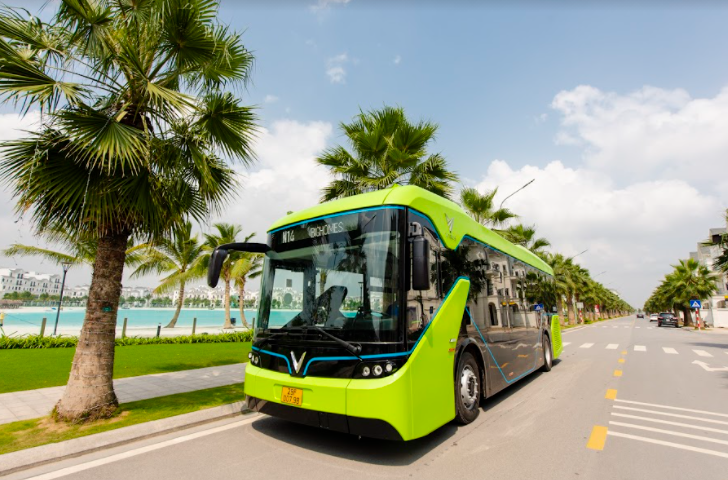
Electric VinBus buses are now being deployed in Vietnam.
Pursuing environmental sustainability benefits everyone. This model is being replicated and shared to bring successful smart electric bus management systems to many countries worldwide.
For more project information, please contact nexcom.vn for further details.
======================
Công ty TNHH công nghệ thông minh ICOMTECK
 Fanpage: https://www.facebook.com/icomteck/
 Website: www.icomteck.vn | www.nexcom.vn
 Hotline: 024 38 389 389 | Zalo: 091 237 5378
 Về trang trước
Bài liên quan

03/12/2025

24/10/2025

24/10/2025

16/09/2025

28/11/2023

28/11/2023

28/11/2023
28/11/2023

28/11/2023

28/11/2022

23/11/2023
23/11/2023